If you have been eyeing land in Burningtown near Franklin, you already know one thing: two parcels with the same acreage can be very different in real life. In this mountain market, the big questions are not just price and size. They are whether the land has workable access, supports septic and a well, and fits your plans without expensive surprises. This guide will help you focus on the details that matter most so you can buy with more confidence. Let’s dive in.
Burningtown land varies more than you may expect
Burningtown is not a one-size-fits-all land market. At the time of research, available parcels ranged from 0.73 acres to 87.778 acres, with several listings in the 2- to 7-acre range. Current examples also show both smaller build-site parcels and larger tracts that may appeal to buyers looking for more privacy, flexible use, or a retreat-style setting.
Just as important, listings describe very different site conditions. Some have private-road access, while others have paved or gravel-road frontage. You may also see land described as level, rolling, partially wooded, private, valley view, or year-round view.
That is why site quality matters more than acreage alone. A smaller tract with easier access and better building conditions may be more practical than a larger parcel with steep terrain or uncertain utility options.
Focus on terrain before you focus on dreams
Mountain land can be beautiful, but beauty does not always equal buildability. Macon County GIS includes layers for contour lines, FEMA flood zones, protected watersheds, soils, parcel lines, structures, and more. Those tools matter because many Burningtown-area properties sit on rolling ground rather than flat building sites.
County property card examples in the area show elevations around 2,041 feet and 2,563 feet, with topography labeled rolling. That does not mean a parcel will not work for your plans. It does mean you should understand how slope may affect driveway placement, home site options, septic layout, and site-prep costs.
Before you fall in love with a view, study the shape of the land. A great-looking tract may still need more grading, more road work, or a more creative building plan than you first expected.
Why slope changes the budget
Slope can affect far more than where you place the house. It can influence driveway design, stormwater flow, excavation needs, and how much usable area you really have. On mountain property, the part of the land you can actually use often matters more than the total acre count.
Even smaller projects may need county review for grading or road work. Macon County’s development checklist says projects involving less than 1/2 acre should still be checked with the county for road-grade and groundcover guidance.
Road access can make or break a parcel
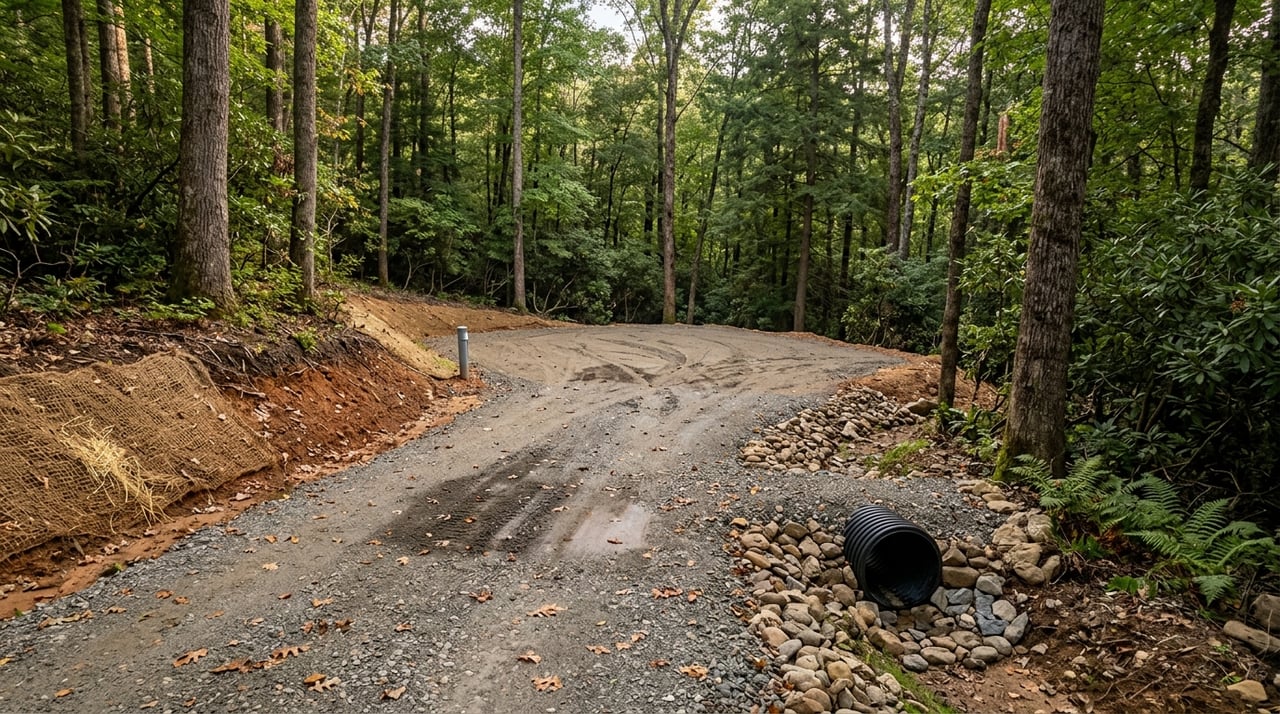
Access is one of the biggest due-diligence issues in Burningtown. Current listings include parcels with private road, state/paved road, and gravel road frontage. That means you should confirm exactly how you get to the property and whether that access works year-round.
For private-road tracts, ask practical questions early. Is there a recorded easement? Who maintains the road? Can service, utility, and emergency vehicles reach the site without trouble? These details can shape both your day-to-day experience and your future costs.
If access connects to a North Carolina state highway, an NCDOT driveway permit is required to obtain or modify that access. NCDOT states there is no application fee, and simple requests may take four weeks or less, while more complex requests may take eight weeks or more.
North Carolina also states that private driveways or roadways cannot intersect state highways without approval from the Department of Transportation. If you are buying raw land, that is a detail worth checking before you assume your future driveway plan will work.
What to verify about access
Here is a simple checklist to use when reviewing a Burningtown parcel:
- Confirm whether access is by private, gravel, or state-maintained road
- Ask whether access is recorded and permanent
- Clarify who maintains the road and how maintenance is handled
- Review whether the route appears usable in all seasons
- Check whether a driveway permit may be needed for state-road access
Utilities are not something to assume
In unincorporated Macon County, public water and sewer are often limited. County information notes that these areas often rely on well and septic rather than public utilities. That makes utility due diligence a major part of buying land in Burningtown.
You may see improved parcels in the area with electric, water, and septic already noted on county tax cards. Still, that does not mean the vacant parcel next door will have the same setup or the same ease of development. Each site needs its own review.
If you are comparing land, try to think beyond the listing remarks. The better question is not just, “Are utilities nearby?” It is, “What has been approved for this specific parcel, and what will it take to make my plan work?”
Septic approval is a key step
Macon County Environmental Health says a septic application is not complete until payment and a site plan are received. The site plan or survey plat should show the driveway, building location, well area, and septic area.
The county also notes that soil texture, soil depth, topography, and the size of the suitable area all matter. A replacement, or repair, area is also required in case the first system fails.
For buyers, the takeaway is simple: do not assume a parcel will perk just because nearby homes exist. The county says a normal site evaluation is usually completed within about 4 weeks, which makes early planning important.
Well permitting also matters
For private wells, North Carolina requires a well construction permit from the local health department before construction, repair, or permanent abandonment of a private drinking water well. Before issuing that permit, the local health department evaluates topography, landscape position, available space, and possible contamination sources.
The permit is valid for five years. That gives buyers some timeline clarity, but it still reinforces the larger point: on mountain land, utility feasibility should be confirmed, not guessed.
Check subdivision rules before you buy bigger acreage
If you are buying land with plans to split it later, do your homework up front. Macon County subdivision regulations apply outside incorporated municipalities, and the county ordinance page shows those rules were amended through December 12, 2023. The ordinance states that no subdivision plat may be filed or recorded until it has been approved.
One rule is especially useful for acreage buyers. Divisions into parcels greater than 10 acres with no road right-of-way dedication are not subject to the subdivision regulations, while smaller splits or divisions involving roads are.
That does not mean every future division will be simple. Macon County’s request-for-division process says the division survey must be submitted for review and approval by Planning and recorded before dividing the parcel.
Why future plans matter now
Some buyers want land for a home now and possible division later for family, resale, or long-term flexibility. That can be a smart plan, but only if the parcel supports it under county rules. A tract that works well as one holding may not divide the way you expect.
If future division is important to you, make that part of your due diligence from day one. It is much easier to verify the rules before closing than to discover limitations after you own the property.
Flood and watershed review should stay on your list
Not every land buyer thinks about flood or watershed restrictions right away, especially in a mountain setting. But Macon County’s development checklist says buyers should check whether a property is in a Special Flood Hazard Area or Watershed District, because development restrictions may apply.
Macon County GIS makes that review easier by offering flood-zone and protected-watershed layers. This is one more reason to look at land through a practical lens. A parcel can look private and peaceful while still carrying development limits that affect where and how you build.
What a smart Burningtown land search looks like
If you are shopping for land near Franklin, it helps to narrow your focus around function, not just scenery. Burningtown can offer a lot of appeal for buyers who want room to spread out, privacy, or a mountain retreat feel. The key is matching the parcel to your actual goals.
A smart search often starts with questions like these:
- Do you want a straightforward homesite or a larger retreat-style tract?
- Are you comfortable with private-road access if the easement and maintenance are clear?
- Will you need room for a future garage, workshop, or additional improvements?
- Is future parcel division part of your long-term plan?
- Do you want a site that may be simpler for remote planning and coordination?
When you answer those questions first, it becomes easier to rule out land that looks good online but may not fit your budget, timeline, or comfort level.
A calm approach helps you buy better
Buying mountain land can feel exciting and overwhelming at the same time, especially if you are purchasing from out of area. In Burningtown, the best decisions usually come from slowing down and checking the details that affect real-world use. Access, road maintenance, septic feasibility, well permitting, flood and watershed review, and subdivision rules all deserve close attention.
The good news is that you do not need to know everything on day one. You just need a clear process, solid local guidance, and the patience to verify what matters before you commit.
If you are considering land or acreage in Burningtown near Franklin, Matt Jackson can help you sort through the practical details with a calm, no-pressure approach.
FAQs
What should buyers check first on land in Burningtown near Franklin?
- Start with access, slope, septic potential, well requirements, and whether the parcel sits in a flood hazard area or watershed district.
Can you build on any acreage parcel in Burningtown?
- No. A parcel still needs to work for legal access, septic, a well, and county permitting before it is truly buildable.
Do Burningtown land buyers need a survey?
- A survey is strongly recommended because the county septic process expects a survey plat or site plan showing the building area, driveway, well area, septic area, and property corners.
Are public water and sewer common for land in unincorporated Macon County?
- Usually not. County information says unincorporated areas often rely on private well and septic systems because public utilities are limited.
Can buyers split acreage later in Macon County?
- Possibly, but the division must follow Macon County rules, and a division survey must be reviewed, approved, and recorded before the parcel is officially divided.
Should private-road access on Burningtown land be a red flag?
- Not automatically, but it should prompt questions about recorded access, maintenance responsibility, and whether the road works for year-round use and any needed permits.